Fertilize fescue this week!

23 11 2009

If you have cool season grass, fescue, growing here in the U.S. this coming week is the second major holiday of the cool season to celebrate by fertilizing your lawn. The first is Labor Day in September, the second is Thanksgiving, and the last holiday of the cool season to fertilize your lawn is Valentine’s Day.  Cool season grasses like to have fertilizer when they can use it — during cool seasons. Another reason you apply it during the cool season is that the weeds that are ever-present in your lawn won’t get much help from it because many of them die back during the winter. The fescue uses the fertilizer and there isn’t  much left for the thuggish weeds in the late spring and summer.

Municipal governments and environmentalist would prefer you not put too much nitrogen close to the edges – near curbing or the driveway — where it can run off into the nearby streams and then into rivers. If you have questions, feel free to contact me.


What to do?

12 11 2009

Recently a customer called me to look at the dryer vent in her house. The washer and dryer are on the second floor in a laundry room not located on an outside wall. The flexible dryer vent is made of white plastic and is not up to current standards — it should be replaced with a foil vent. The problem is buried in the details above. The dryer is on the second floor and the attic has been finished. Trying to replace the vent could be difficult and expensive. I can’t simply run a new vent to an outside wall to solve the problem. I may have to remove flooring on the second floor or take out the ceiling on the first floor. I might be lucky enough to be able to remove flooring in a closet behind the laundry room and route the new duct work through there. Or I might find rigid duct work buried under the floor to which I can connect the flexible duct. What would you do?  Let me know.


Another skill to add to my resume

5 11 2009

A client recently called and wanted to know if I could find replacement plastic sliders for the bottom of the legs of chairs in her church. I used one of the chairs as a template. I looked everywhere for those sliders. I called many places in town. One person said “I think you called here about 3 weeks ago and I still don’t have any idea where to find them.” I assured him that I had not called before. Finally, I found them on the internet. I replaced the sliders in the chair and delivered 350 of them for church members to install (maybe during a boring sermon).


Horror Alert for your small engines

5 11 2009

Twice this year I’ve worked on small engines (a lawn mower and a leaf vacuum) that mysteriously would not run. On the lawnmower I worked for over an hour to find the coil not working. I replaced the coil and the engine still wouldn’t run.  I won’t bore you with all the details, but what had happened was that something other than gasoline had been poured into the gas tank. It smelled like gasoline. But the engine wouldn’t run. I  tried the usual corrective measures to get the engine to run. It just wouldn’t. So I drained the gas tank and put in some of my gasoline. This time when I pulled the rope it ran. When I returned it I mowed a strip to the shed where the lawn mower is stored. About 2 days later the owner called again. Again the mower wouldn’t run. And again I put my own gas in the mower and it ran. In the owner’s storage shed I discovered 2 cans —  one had gasoline in it and the other contained some other petroleum-based distillate but  not gasoline. No more problems with that mower.

This week a client brought me his leaf vacuum  because it wouldn’t run. Of course, this is precisely the time of the year he wants it to run. The vacuum’s engine had spark and it had fuel, so why wouldn’t it run?  I drained the fuel and put in some of my gasoline. It cranked and ran great.

Be very meticulous about fuels you keep on hand. Most lawn mowers, tillers, leaf vacuums, and chipper-shredders need a good grade of gasoline. Most string trimmers, small edgers, hand held leaf blowers, gas powered hedge trimmers, and chain saws need gas mixed with either oil or a chemical lubricant. I have several of these pieces of equipment and they all need different mixes of oil. One needs a 50:1 mix of gasoline and oil, another needs a 40:1 mix, and another needs a 25:1 mix. I can’t tell you the proper mix to use in each tool — I refer to the fuel can and sometimes the owner’s manual for the particular piece of equipment. Since you only use these engines a couple of times each year, do yourself a favor and mark the engine AND the can so you can quickly determine which fuel mix you need. A Sharpie is a great thing!


More interesting jobs.

2 11 2009

Recently I was asked to add quarter-round to the baseboard in a room where the carpet had been removed. I explained that quarter- round was not the proper molding but if that was what the homeowner wanted, I would use it instead of shoe molding. To explain that a little, if you put 4 pieces of quarter-round together you get roughly a circle If you put 4 pieces of shoe molding together you have an oval. Shoe is a little taller than deep. Quarter-round is the same in both dimensions. I measured, cut, installed and caulked. The client was very happy.

I was also hired recently to install molding to surround vinyl lattice. The original installation wasn’t done properly.  The lattice was neither level or plumb. The installer also didn’t make sure that the bottom of the lattice was even or slightly higher than the bottom brace, so I had to cut the bottom of the lattice and then install about 30 feet of molding.  The same client has a storage room installed under the deck. It has 2 doors. One door was allowing water in and it was beginning to rot the floor. For this particular job there was no specified “fix” so I used garage door molding to create a drip edge that will let the water drip out farther from the door so it will not get behind the door to rot the floor. These are the type of jobs I like. I have to create a solution for the problem and then implement the fix. This is one of the reasons I am enjoying the types of handyman work that I do — it’s not the same thing over and over again.  Can you tell I like the variety?


It is fall and it is time to plant, plus more.

23 10 2009

Fall is the time to plant, especially woody plants. They will grow even in the winter and this time of the year is less stressful than say… July and August. I enjoy planting and gardening. Let’s make a plan and get in the gardens.

About a month ago I moved 2 shrubs I had planted last November. I originally planted 3 in one part of this garden and 1 didn’t make it. As I was moving the 2 I noticed the root system was very dry. I asked about the watering schedule and was told that the water was currently turned off in that part of the garden. I asked about the watering schedule immediately after I planted them originally. They were not watered much then either. These particular shrubs are leafy evergreens and need more water than a deciduous shrub that goes mostly dormant in the winter. I checked again this week on the 2 I had moved and they seem to be holding on. I hope they make it. They have been through dry times since I moved them and the leaves still look normal. If you plant something now be sure to water it regularly if you want it to live and thrive.

I was listening to Mike McGrath a couple of weeks ago on “You Bet Your Garden” on Public Radio East and heard some new, at least to me, information. It is probably not a good idea to use wood chips as mulch in the garden. The wood chips decompose and, if I understood correctly, during the process they out-gas a substance harmful to tender plants. This out-gassing  encourages molds and mildew.  That is enough reason for me to change my practice and use another mulch in my own gardens. The alternative suggestion is to use composted leaf mold — the same material people (1)rake to the curb in the fall, (2)let the municipality collect it,  and then (3)buy back, either completely broken down or partially broken down, in the spring. The composted leaves  add nutrients to your gardens, hold moisture during dry times, amend the soil over time, and are not quite so attractive to pests that like to nest in the wood chips. I am going to research this further and will get back to you.

Since it is fall and the very leaves I just mentioned have begun to fall, you need to keep your gutters and downspouts clean. If you don’t, when it rains water will spill over the front and back of the gutters and will eventually rot the fascia board. It is much less expensive to clean the gutters — or have someone do it for you — than to have someone remove the gutters, replace the fascia, paint the fascia, and then rehang the gutters. If you have pine trees in your yard, have the gutters cleaned at least 4 times a year. If you have only hardwoods, you can usually get by with two cleanings annually. If you need help with the cleaning of the gutters and downspouts just give me call.

I recently pruned some plants that were searching for light. They had gotten very tall and skinny in the process of trying to reach the light. I advised the owner they might not recover from the severe pruning at this time of the year. Pruning, especially hard pruning, should really be done in the late winter or very early spring. I’m interested to see if or how many of the stumps survive. More on that next spring.

I recently worked in a historic building trying to remedy a sound migration problem. I insulated the walls and other areas where sound might infiltrate into otherwise quiet spaces. The space I worked in was very tight. If you’re are claustrophobic, you might not want to read the rest of this paragraph! It was so tight I made sure my cell phone worked as I was nearing the tightest area, just in case I  needed help getting back out. It was TIGHT. When the job was done it was rewarding to know I was able to fit into that opening, get back out,  and do the job I went there to do. Did I mention it was tight? The shop over the insulated area is not open to the public yet, so when it opens I’ll be better able to determine how successful I was.

It seems that when I do a particular type of job,  I get several calls within the next couple of weeks to do the same type of project again. Several weeks ago I replaced about 10 pieces of siding on a client’s home with Hardiplank. About 2 weeks later I was called to replace siding for another client. And then another call to do the same for a 3rd client. That was the end of the siding run. The same situation happened again a week later with a call to hang drapes. I was called twice more within 2 weeks to hang more curtains and drapes. I enjoy just riding the wave and waiting for the next big one. Life is good!

One last thought. The Interfaith Food Shuttle gave us a tally of how many pounds of vegetables we gave them from the “guerrilla garden” at our church — St. Giles Presbyterian. We grew and donated 451 pounds this summer and early fall! We now have a fall/winter garden. I will report more as the season progresses.

Thanksgiving , Christmas, and Chanukah are right around the corner. If you need help preparing your yard and home for those wonderful and festive occasions, let me know.


My summer vacation

8 09 2009

Now that Labor Day has passed, those of you with warm season grasses should be about ready to retire your lawn mowers for the cool season. Remember to run the mower until it runs out of gasoline before storing for the winter. Old gasoline will impede operation of the carburetor when you try to start the mower again in late spring. (This also holds true for tillers, string trimmers, leaf blowers and other gas powered equipment that is going to be stored for the off season.)

This summer I’ve changed window sashes for a number of clients. If you’re looking to upgrade your windows, sash replacement is a less expensive way to get the features of the latest windows.

I’ve spent a number of days maintaining a 100-year-old commercial building in Apex. The building used to be a hardware store with hay stored in a loft. Now that loft is the home to an engineering firm and the street level occupants are retail businesses. The lowest level houses a music school and a magician! It’s been a joy working amidst the variety of creative professionals in this interesting refurbished downtown space.

And then for a bit of frivolity, I helped a client haul brush into the woods where I was bitten by more than a dozen ticks of varying sizes. On my doctor’s recommendation, I was treated prophylactically for a number of tick-borne ailments!

I look forward to hearing from you soon to schedule an attack on YOUR honey-do list. As always, no job is too small.


Guerilla gardening

22 07 2009

Bobcat DougIn April of this year a group of friends and I decided to plant a garden in a bright, sunny spot at our church where we would grow vegetables for the Raleigh Interfaith Food Shuttle. In this picture I’m just starting to break ground for the new bed. So far we’ve taken over 100 pounds of tomatoes, cucumbers, yellow squash and zucchini to the Food Shuttle. We hope to have a nearly year-round source of vegetables to share with the community. I’d encourage you and your friends to help feed the hungry with a similar community garden plot!


De-bunking & Debunking

26 03 2009

First the de-bunking. Early this week I disassembled a set of bunk beds, providing the 12-year-old occupant with the additional wall space he wanted and a matching set of twin beds.
Then on to debunking. While you might think you’ll have to mow your fescue less if you mow shorter, you’re actually giving weeds an extra opportunity to germinate when you expose them to more heat and light. Let that taller, lush fescue shade out the weeds by setting your mower blade height to 3″-4″. For the most part, the weeds grow faster than the fescue, leading to MORE mowing – not less – to maintain a neat appearance. Occasionally I’ve had to install slightly larger wheels on a client’s mower to get the mowing deck high enough for the ideal height for our lovely fescue lawns here in the Piedmont.
My other projects this week have been varied – just the way I like it! I replaced hinges on a crawlspace door and removed the threaded metal portion of a broken lightbulb from the socket; cleaned the stones on a fireplace in a room with a cathedral ceiling; replaced a bathroom exhaust fan switch, built a treated wood landing at the bottom of steps from a deck to avoid stepping into a boggy area; and cleaned the interior and exterior windows on a screened porch (Windows on a screened porch you ask? Just transom-type windows at the top of the gable end.).


Garden Hardscapes

23 03 2009

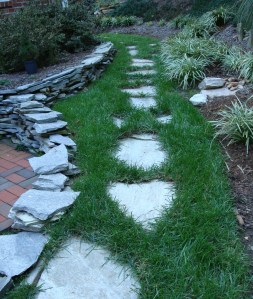
gospodareks-path1One of my favorite types of projects involves developing a pleasing landscape for a client’s yard. The project can range from very simple and inexpensive (the selection and planting of a single eye-catching shrub with year-round interest near the entrance or a single large rock strategically placed in the home garden) to larger and more complex hardscaping projects that  evolve over time along with the vegetation.  Here are a couple photos from the lawn and garden of one of my long-time clients. Over time I’ve added the patio, stone paths, and dry-stack stone walls outlining planted areas.gospodareks-patio4